Introduction
The name Darjeeling is a composition of 'dorje' meaning
'thunderbolt' and 'ling' meaning 'place' ... 'the Land
of Thunderbolt'.
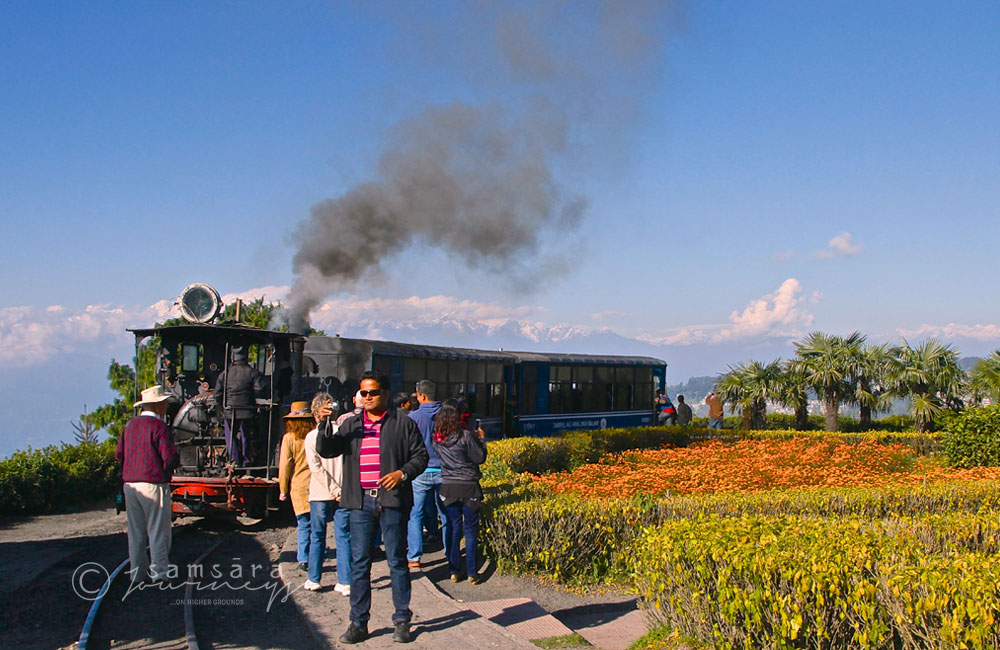
The Darjeeling Himalayan Railway is lovingly called
the "Toy Train". The journey to Darjeeling
is regarded as among the most spectacular in the world.
Travelers are awed by both the scenery through the
tea gardens as well as the railway line which is truly
an engineering masterpiece and without doubt one of
the wonders of the world.
Darjeeling is also very popular for its tea which
is branded as one of the best teas in the world.
The town and hill station of Darjeeling lies in northern
West Bengal, India. Darjeeling district lies between
26° 31' and 27° 13' north latitude and between
87° 59' and 88° 53' east longitude.
Altitude:
Comprising mainly of mountain terrain, Darjeeling stands at a height of 2134m
(7053 ft) on a mountain ridge.
Area:
Darjeeling town covers an area of 11.44 sq. kms.
Population:
About 100,000.
Languages spoken:
English, Nepali, Hindi, Tibetan and Bengali.
Climate:
Almost every year Darjeeling's temperature drops below freezing during the
winter season, from November to February. In summer, Darjeeling is delightfully
cool with the maximum temperature reaching about 20°C.
Rainfall:
Rain falls mostly during months from June to September. The annual recorded
rainfall in Darjeeling is 320 cms.
Clothing:
Light woolen for summer and heavy woolens for winter.
Best months to visit:
March to mid-June and September to mid-December.
Kalimpong
Though not as widely known about as Darjeeling
this town is famous for its flower nurseries, quaint
European styled cottages and was a bustling commercial
centre when the Indo-Tibet border was open. The vestiges
of the era can still be felt in its market places.
|